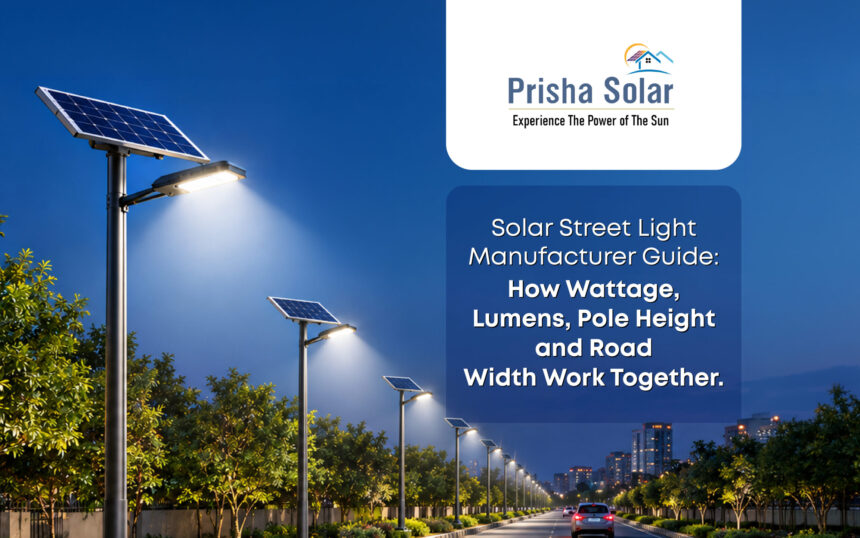
Choosing a solar street light manufacturer should start with lighting design, not fixture wattage. Road width, pole height, spacing, lumen output, optics, battery capacity, solar panel size, and local sunlight conditions work together. A properly planned system aims to deliver useful, uniform illumination without oversizing equipment or leaving dark patches.
Table of Contents
- Introduction
- Solar street light manufacturer selection starts with lighting design
- Wattage and lumens are not the same thing
- Pole height and road width shape coverage
- Pole spacing and optics determine uniformity
- Solar panel and battery sizing support the lighting plan
- What buyers should ask before approving a quotation
- Conclusion
- FAQs
1. Introduction: A Bigger Wattage Number Does Not Automatically Mean Better Lighting
Imagine you are planning lighting for a society road, factory campus, parking area, or internal driveway. One supplier recommends 30 W lights. Another says 60 W. A third proposes 90 W.
Which one is right?
Honestly, the wattage number alone cannot answer that.
Street lighting is a design problem. Road width, pole height, light distribution, solar generation, and battery support all matter.
So the useful question is not, “How many watts do we need?” It is, “What lighting result does this location need?”
2. Solar Street Light Manufacturer Selection Starts With Lighting Design
A good supplier should assess the site before recommending a product.
2.1 Start With the Area Being Lit
Is it a residential lane, factory road, parking area, garden path, or wider internal road?
Useful site inputs include:
- Road or pathway width
- Desired pole positions
- Existing pole height
- Traffic and pedestrian use
- Nearby trees or buildings
- Night-time operating hours
- Local solar exposure
- Safety-sensitive areas
BIS guidance notes that mounting height, spacing, road geometry, and light distribution influence lighting quality.
Catalogue wattage should never replace a site assessment.
3. Wattage and Lumens Are Not the Same Thing
Here is where solar street lighting gets interesting.
3.1 Wattage Tells You Power Use
Watts describe electrical power consumed by the luminaire. They do not directly tell you how much useful light reaches the road.
Two LED fixtures with the same wattage can produce different lumen outputs because efficacy, optics, and drivers differ.
3.2 Lumens Tell You Light Output
Luminous flux, measured in lumens, describes total visible light emitted by the luminaire.
But even lumens do not tell the complete story.
A fixture can produce many lumens yet send too much light outside the required area.
That is why photometric distribution matters.
The same applies to residential solar panels: headline capacity matters, but system design decides fit.
4. Pole Height and Road Width Shape Coverage
When evaluating a solar street light manufacturer, look carefully at the relationship between mounting height and road geometry.
4.1 Higher Poles Spread Light Over a Larger Area
A higher mounting position can increase coverage but may require more output to achieve intended illuminance at ground level.
BIS considers mounting height alongside source power, light distribution, road type, and geometry.
So “higher is better” is not a design rule.
4.2 Road Width Changes the Required Arrangement
A narrow internal lane may be served from one side. Wider roads may need staggered poles, opposite-side arrangements, or another configuration depending on lighting requirements.
Pole height should not be chosen independently of road width.
For industrial solar panels, engineers match modules and electrical design to the factory. Street lighting deserves the same site-specific thinking.
5. Pole Spacing and Optics Determine Whether the Road Looks Evenly Lit
Have you driven through a road where every pole creates a bright circle followed by a dark patch?
That is often a spacing and distribution problem.
5.1 Bigger Spacing Can Create Dark Zones
Increasing pole spacing can reduce pole count and initial cost. Push spacing too far and lighting can become patchy.
BIS guidance identifies pole spacing as a major design component because longer spacing can reduce luminance and uniformity.
5.2 The Luminaire Optic Directs the Light
Street-light optics shape where light travels.
Different beam distributions suit different road widths, pole positions, and heights. Suppliers should support recommendations with photometric data when needed.
Simply multiplying poles by wattage misses this part.
6. Solar Panel and Battery Sizing Support the Lighting Plan
Once the lighting requirement is defined, the solar-energy system has to support it.
6.1 Battery Capacity Is About the Night-Time Duty
The battery stores daytime solar energy for use after sunset.
Required capacity depends on luminaire load, dimming, operating duration, system losses, and low-sun design.
Modern products may use motion sensing or programmed dimming to manage energy through the night.
6.2 The Solar Module Must Replenish the Energy
Like residential rooftop solar panels, the module needs appropriate exposure and should avoid unnecessary shading from trees, buildings, or obstacles.
This is familiar territory for solar epc companies in ahmedabad: solar irradiation, orientation, shading, and system losses matter whenever generation supports an electrical load.
For an industrial solar panel installation, the load may be factory equipment. Here, it is the lighting system and battery.
7. What Buyers Should Ask Before Approving a Solar Street Light Quotation
A quotation is easier to compare when each supplier explains the design assumptions.
7.1 Request These Technical Details
Ask for:
- Luminaire wattage
- Lumen output
- LED efficacy
- Recommended pole height
- Proposed pole spacing
- Road width considered
- Beam or optical distribution
- Solar module capacity
- Battery type and capacity
- Charge controller details
- Dimming or sensor profile
- Expected operating duration
- Ingress protection rating
- Warranty terms
Also ask whether foundations, installation, transport, and commissioning are included.
For larger sites, request a layout showing pole positions.
A professional proposal should clearly explain why the selected configuration fits your location.
8. Conclusion: Design the Road First, Then Choose the Product
Choosing a solar street light manufacturer should be less about finding the biggest wattage and more about matching light output, optics, pole height, spacing, road width, battery storage, and solar generation.
At Prisha Solar, the goal is to consider the real application before recommending a configuration.
When these pieces work together, solar street lighting becomes easier to evaluate and operate.
Good lighting comes from a well-matched system.
9. FAQs
9.1 How Many Watts Does a Solar Street Light Need?
There is no universal wattage. Road width, pole height, required lighting level, optics, spacing, operating hours, and product efficiency all influence selection.
9.2 Are More Lumens Always Better?
No. Lumen output matters, but beam distribution and placement determine how effectively that light reaches the required area.
9.3 How Does Pole Height Affect Solar Street Lighting?
Pole height influences coverage, intensity at ground level, glare, and uniformity, so it should be selected with road geometry and luminaire optics.
9.4 How Far Apart Should Solar Street Light Poles Be?
Spacing depends on pole height, road width, luminaire distribution, required lighting level, and layout. A site-specific design is preferable to one fixed spacing rule.
9.5 What Should I Compare Between Two Solar Street Light Quotes?
Compare lighting design assumptions, lumens, wattage, optics, pole height, spacing, battery, solar module, controls, warranty, installation scope, and documented exclusions.