

Residential rooftop solar panels can work well in apartments and housing societies, but the society must identify usable roof space, common electricity loads, ownership and access rights, shading, structural suitability, meter arrangements, approvals, and future maintenance. A good plan begins with the building, not the panel count.
Table of Contents
- Introduction
- Where residential rooftop solar panels can be installed
- Start with common-area electricity loads
- Understand roof ownership and usable space
- Check technical suitability before finalising capacity
- Decide how metering and approvals will work
- Plan access, maintenance, and future expansion
- Conclusion
- FAQs
1. Introduction: Apartment Solar Starts With a Different Question
For an independent house, rooftop solar can feel straightforward: one owner, one roof, one electricity connection.
Apartments are different.
You know what happens in a housing society? Everyone can like the idea of solar, but practical questions arrive quickly. Which roof is common property? Will the system offset lift and water-pump consumption? Can individual residents use part of the terrace? Who approves maintenance access?
That is why residential solar panels should begin with a site-and-load study rather than a rough panel estimate.
Identify where solar can physically sit, which electricity connection it should serve, and how the society will manage it.
2. Where Can Residential Rooftop Solar Panels Actually Be Installed?
The obvious answer is “on the terrace,”
2.1 Main Terrace and Open Roof Areas
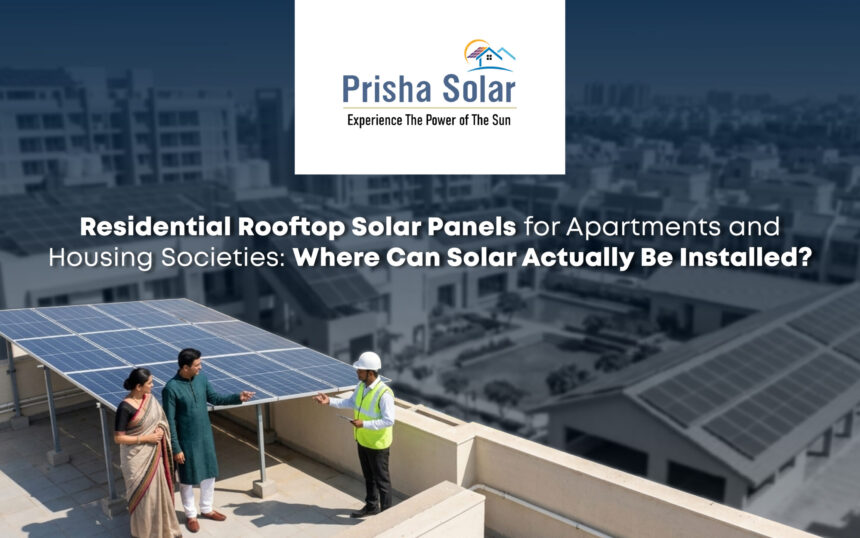
The primary terrace is usually evaluated first. Installers look for clear areas with good solar exposure while accounting for water tanks, lift rooms, parapet walls, staircases, antennas, ducts, and movement paths.
2.2 Clubhouse, Parking, and Other Common Structures
Depending on the property, solar may also be considered over clubhouses, community buildings, security cabins, or purpose-designed parking structures.
Each structure needs engineering review before modules are placed there.
A housing society solar system should therefore follow actual site conditions, not a generic “square feet per kW” assumption.
3. Start With Common-Area Electricity Loads
Before discussing system size, look at what society already consumes.
3.1 Which Loads Can the Society Target?
Common area electricity may include:
- Lifts
- Water pumps
- Corridor and basement lighting
- Clubhouse loads
- Security systems
- Gate equipment
- Common ventilation
- EV charging infrastructure
A rooftop solar installation designed around these loads can be easier to justify than selecting capacity first and asking what to do with the generation later.
Solar panels for home price comparisons work differently for an individual homeowner because one household bill and consumer connection usually drive the decision.
4. Roof Ownership, Rights, and Space Allocation Matter
Here is where residential rooftop solar panels planning becomes more about the building community than the equipment.
4.1 Common Solar vs Individual Resident Solar
A society may explore a common plant for shared facilities, individual systems where rules and roof allocation permit, or a combination of both.
Under PM Surya Ghar, Group Housing Societies and Residential Welfare Associations are included for rooftop solar serving common facilities, including EV charging, subject to scheme conditions and applicable capacity limits.
The society should document who controls the roof, how space is allocated, who can enter solar areas, and whether future building works could affect the installation.
4.2 Keep Future Roof Use in the Conversation
What happens if the society installs panels everywhere and later needs waterproofing, tank repairs, or access to a lift room?
Keep service corridors and essential roof access available rather than treating every empty meter as panel space.
5. Check Technical Suitability Before Finalizing Capacity
5.1 Shade, Orientation, and Structural Condition
An installer should assess shading from nearby towers, tanks, walls, trees, and rooftop equipment. In dense urban areas, shadows can change throughout the day and across seasons.
The roof or supporting structure should also be reviewed for the proposed mounting arrangement and loads.
This engineering discipline also applies to industrial solar panels, although residential societies have different load patterns, access conditions, and project scale.
5.2 Plan the Electrical Route Too
The design needs a practical route for DC and AC cabling, inverter placement, electrical protection, earthing, and connection to the relevant meter or distribution point.
A technically possible roof position may be awkward if cable routes become unnecessarily long or difficult.
6. Decide How Metering and Approvals Will Work
6.1 Identify the Electricity Connection Being Served
Establish which consumer connection to the solar plant is intended to offset.
For a common system, this may be a society or common-facility connection. Applicable net metering, DISCOM approval, connection limits, documentation, and scheme eligibility should be verified for the specific project and current regulations.
If comparing solar epc companies in Ahmedabad, ask each bidder to state how the proposed electrical and approval route applies to your society.
7. Plan Access, Cleaning, and Ownership After Commissioning
7.1 Decide Who Will Manage the System
The committee should know who receives monitoring access, stores invoices and warranty documents, and becomes the service contact.
If professional solar panel cleaning services are used, clarify rooftop access rules, safety requirements, visit frequency, and who authorizes personnel.
7.2 Use a Site Survey Checklist Before the Final Quote
Before approving capacity, confirm:
- Available roof zones
- Major shading obstacles
- Structural review requirements
- Common electricity consumption
- Meter details
- Cable routes
- Inverter location
- Maintenance access
- Water tanks and utility areas
- Future rooftop work
- Approval responsibilities
- Monitoring ownership
It turns “Can our society go solar?” into a project that can actually be evaluated.
8. Conclusion: Apartment Solar Works Best When the Building Comes First
Residential rooftop solar panels can be practical for apartments and housing societies when roof space, electricity use, ownership, engineering, metering, approvals, and maintenance are planned together.
It is understanding how your building works.
At Prisha Solar, that means looking at the site, common loads, usable solar zones, electrical connection, and long-term access before recommending a system.
When the building plan makes sense first, the solar plan becomes clearer.
9. FAQs
9.1 Can an Apartment Society Install Rooftop Solar?
Yes, subject to suitable space, technical feasibility, society permissions, electricity connection requirements, and applicable regulations.
9.2 Can Solar Power Be Used for Lifts and Water Pumps?
A properly designed common solar system may offset eligible common-facility electricity consumption, depending on the connection and system arrangement.
9.3 Can Individual Flat Owners Install Their Own Solar Panels?
Possibly, but roof ownership, space allocation, society rules, metering, and DISCOM requirements must be checked first.
9.4 How Much Roof Space Should a Society Reserve?
There is no universal answer. Module choice, obstacles, access paths, shading, structure, and layout affect usable area.
9.5 What Should a Housing Society Check Before Requesting Quotes?
Start with electricity bills, meter details, roof drawings, usable areas, shading, access, society approvals, and the intended purpose of the system.