

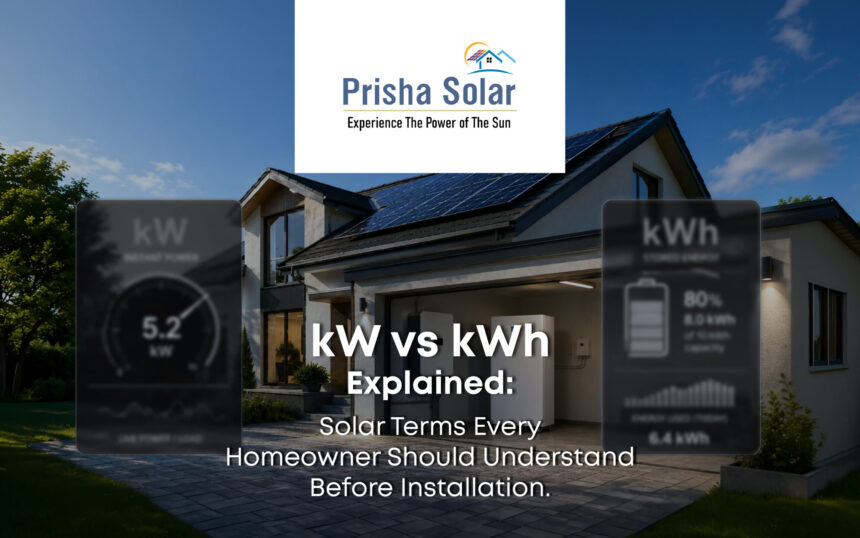
Before installing residential solar panels, understand the difference between kW and kWh. Kilowatts measure power or capacity at a particular moment, while kilowatt-hours measure energy produced or consumed over time. Your solar system may be rated in kW, but your electricity bill records kWh. Knowing both helps you compare system size, generation estimates, household usage, and solar proposals confidently.
Table of Contents
- Introduction
- Residential solar panels: kW and kWh made simple
- Why solar systems are sized in kW
- Why bills and solar generation use kWh
- How kW and kWh work together at home
- Other solar terms worth understanding
- Questions to ask before approval
- Conclusion
- FAQs
1. Introduction: Two Similar Abbreviations Mean Different Things
You receive a quotation for a 5 kW solar system. Your electricity bill says you used 650 kWh last month.
Those numbers look related, but they describe different things.
You know what makes solar conversations easier? kW describes power, while kWh describes energy over time.
Think of it like this: kW tells you how big the tap is; kWh tells you how much water flowed through it. Once that difference clicks, quotations become easier to read.
2. Residential Solar Panels: kW and kWh Made Simple
Start with the two units homeowners see most.
2.1 What Does kW Mean?
A kilowatt, written kW, is a unit of power. One kilowatt equals 1,000 watts.
In rooftop solar, kW commonly describes system capacity. A 5 kW plant therefore has a nominal power rating of around 5,000 watts under specified test conditions.
It will not produce exactly 5 kW every minute. Output changes with sunlight, temperature, shading, orientation, and system losses.
2.2 What Does kWh Mean?
A kilowatt-hour, written kWh, is a unit of energy.
If a 1 kW load operates for one hour, it uses 1 kWh. If a 2 kW appliance runs for two hours, it uses 4 kWh.
Your electricity bill records energy consumption in units, with one unit generally corresponding to one kWh.
3. Why Are Rooftop Solar Systems Sized in kW?
When you compare residential solar panels, installers discuss capacity in kW or kWp.
3.1 kWp Describes Rated DC Capacity
Solar modules have rated wattages under standard test conditions. Add the wattage of all modules and you get the array’s rated DC capacity, commonly expressed in kWp.
Ten 500 W modules provide 5,000 W, or 5 kWp, of rated module capacity.
This number helps describe system size, equipment selection, and roof-space needs.
3.2 Capacity Is Not an Energy Guarantee
Here is where confusion starts.
A 5 kW system does not mean you receive 5 kWh every hour. Sunlight changes through the day, and real systems experience several losses. Installers therefore estimate solar generation separately in kWh.
4. Why Electricity Bills and Solar Generation Use kWh
Your bill measures energy consumed over time, so kWh is the useful unit.
4.1 Read Your Bill as an Energy History
Suppose your home used 600 kWh last month. That shows the household’s energy use for that billing period.
Several months are more useful because cooling, travel, appliances, and occupancy can shift consumption.
This matters when discussing solar panels for home price because sizing should reflect energy needs rather than roof area alone.
4.2 Solar Generation Is Also Tracked in kWh
Your inverter monitoring may show current power in kW and accumulated daily energy in kWh.
For example, the app might show 3.4 kW at noon and 21 kWh generated by evening.
Both numbers can be correct because they describe different things.
5. How kW and kWh Work Together in a Real Home
Imagine a household considering a 4 kW rooftop system.
5.1 A Simple Daytime Example
At one moment around midday, the system might produce 3 kW. If conditions stayed exactly the same for two hours, that period would contribute roughly 6 kWh.
In reality, generation rises and falls, so monitoring adds energy across the day.
5.2 Your Appliances Have Power Ratings Too
A 1.5 kW appliance running for two hours consumes about 3 kWh.
Appliance wattage alone does not show monthly consumption; usage duration matters.
Residential rooftop solar panels are designed around capacity, expected energy production, and household consumption patterns.
6. Other Solar Terms Every Homeowner Should Understand
kW and kWh are the starting point, not the entire vocabulary.
6.1 DC Capacity and AC Capacity
Solar modules produce DC electricity. The inverter converts it into AC electricity for household use and grid interaction.
A proposal may show DC capacity and inverter AC rating separately. Ask the designer to explain the relationship.
6.2 Peak Sun Hours
Peak sun hours are not simply daylight hours.
The term expresses daily solar energy as equivalent hours at 1,000 watts per square metre. It explains why daylight hours alone cannot predict generation.
6.3 Self-Consumption, Export, and System Losses
Self-consumption is solar energy used by your home while it is generated. Export is surplus energy sent to the grid under the applicable metering arrangement.
System losses can come from temperature, cabling, inverter conversion, shading, mismatch, and soiling. Solar panel cleaning services may manage soiling, but not other losses.
7. Questions to Ask Before Approving a Solar Proposal
Once you understand the terms, ask better questions.
7.1 Ask the Installer to Explain These Numbers
Request clear answers for:
- Proposed DC capacity in kWp
- Inverter AC rating in kW
- Expected monthly generation in kWh
- Expected annual generation in kWh
- Household consumption used for sizing
- Estimated self-consumption
- Expected export, where applicable
- Major loss assumptions
- Monitoring access
- Metering arrangement
If you compare solar epc companies in ahmedabad, make sure bidders use similar assumptions.
Industrial solar panels use the same kW and kWh principles, although factory load patterns and project design are different.
A clear proposal should connect capacity, production, and consumption simply.
8. Conclusion: kW Tells You Size; kWh Tells You Energy
Before choosing residential solar panels, remember one simple distinction: kW tells you power or system capacity, while kWh tells you energy produced or consumed over time.
That difference helps you understand quotations, bills, monitoring, and generation forecasts.
Prisha Solar aims to make solar decisions easier.
When the units make sense, technical numbers become useful information.
9. FAQs
9.1 Is 1 kW the Same as 1 kWh?
No. kW measures power, while kWh measures energy used or produced over time.
9.2 How Many kWh Can a 1 kW Solar System Generate?
There is no fixed figure. Generation depends on solar resource, location, weather, orientation, temperature, shading, equipment, and system losses.
9.3 Why Is My Solar System Rated in kW but My Bill Shows kWh?
The system rating describes power capacity. Your bill records electrical energy consumed during the billing period.
9.4 Does a 5 kW Solar System Produce 5 kWh Every Hour?
No. Output varies through the day with sunlight and operating conditions.
9.5 Should I Size Solar Only From Monthly kWh Consumption?
No. Consumption matters, but roof space, daytime load, connection details, shading, regulations, and financial goals should also be considered.